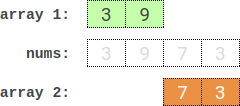
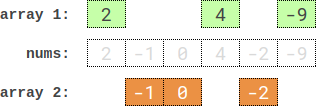
The difference between the two array sums is |A - B|, and since A + B is just the sum of all 2n elements, every partition is fully described by one number: the sum A. Write S for the sum of the n elements you give to the first array; the answer is min |total - 2 * S| over all n-element subsets. Choosing a subset is the whole problem, and there are C(2n, n) of them — about 155 million when n = 15, far too many to list. The trick is to stop treating the array as one pile of 2n: cut it into two halves of n, enumerate each half independently, and match the halves up. Each half has only 2^15 = 32768 subsets, and the matching is a binary search.
Brute Force: Try Every Partition
Time O(C(2n, n) * n)Space O(n)The definition of the problem is an instruction: try every way to pick n of the 2n elements. Each n-subset fixes the first array, the remaining elements form the second, and the absolute difference follows immediately. This is correct by exhaustion, but the count of subsets explodes combinatorially.
from itertools import combinations

class Solution:    def minimumDifference(self, nums: list[int]) -> int:        n = len(nums) // 2        total = sum(nums)        best = float("inf")        for chosen in combinations(range(2 * n), n):            chosen_sum = sum(nums[i] for i in chosen)            # first array sum = chosen_sum, second = total - chosen_sum            best = min(best, abs(total - 2 * chosen_sum))        return best
Why it is too slow: there are C(2n, n) subsets to visit, and each one costs O(n) to sum, so the total is O(C(2n, n) * n) — around 2.3 billion operations at n = 15. Enumeration is the right idea, but it must be done on two half-size piles, not the full array. Storage is just the combination being built, O(n).
Meet in the Middle + Binary Search
OptimalTime O(n * 2^n)Space O(2^n)Cut nums into a left half and a right half, each of length n. For each half, enumerate all 2^n subsets and record the signed sum of the subset: elements given to the first array count +, the rest count -. Group those signed sums by how many elements were chosen, so f[i] holds every signed sum obtainable by choosing exactly i elements from the left, and g[j] does the same on the right.
The reason prefixes f and g fit together is the count constraint. If the left gives i elements to the first array, the right must give exactly n - i, so the total difference for that pair is a + b with a in f[i] and b in g[n - i]. The signed sums already encode both arrays, so no separate subtraction is needed. For each a, the best possible b is the value closest to -a; sort each g group once and find it with a binary search. Checking the insertion point and the element before it covers both neighbors.
from bisect import bisect_left

class Solution:    def minimumDifference(self, nums: list[int]) -> int:        n = len(nums) // 2        left, right = nums[:n], nums[n:]        # f[i]: signed sums of the left half choosing exactly i elements        # g[j]: signed sums of the right half choosing exactly j elements        f = [set() for _ in range(n + 1)]        g = [set() for _ in range(n + 1)]
        for mask in range(1 << n):            s = cnt = 0            for j in range(n):                if mask >> j & 1:                    s += left[j]                    cnt += 1                else:                    s -= left[j]            f[cnt].add(s)
        for mask in range(1 << n):            s = cnt = 0            for j in range(n):                if mask >> j & 1:                    s += right[j]                    cnt += 1                else:                    s -= right[j]            g[cnt].add(s)
        best = float("inf")        for i in range(n + 1):            right_sums = sorted(g[n - i])            for a in f[i]:                target = -a                p = bisect_left(right_sums, target)                if p < len(right_sums):                    best = min(best, abs(a + right_sums[p]))                if p > 0:                    best = min(best, abs(a + right_sums[p - 1]))        return best
Watch the two grouped tables fill one bitmask at a time, then watch the pairing readout binary-search the right table for the complement of each left value.
Left half — choose i for A
Right half — choose n - i for A
f — left signed sums
f[i]: sums from choosing i on the left
g — right signed sums
g[j]: sums from choosing j on the right
each half is enumerated once and sorted; the answer pairs f[i] with g[n - i] by binary search
Split into left [3, 9] and right [7, 3]. Giving i elements to array A from the left forces 2 - i from the right, so both halves must be searched together.
Why it is fast enough: each half enumerates 2^n masks and scans n bits per mask, so building f and g is O(n * 2^n). Sorting all the g groups together is also O(n * 2^n) because each group is at most 2^n long. The pairing loop performs one O(log 2^n) = O(n) binary search per left sum, again O(n * 2^n). At n = 15 that is roughly half a million operations. Space is O(2^n) for the two tables, which hold at most 2^n distinct signed sums each.